
The self-made American, and other stories we tell at 250
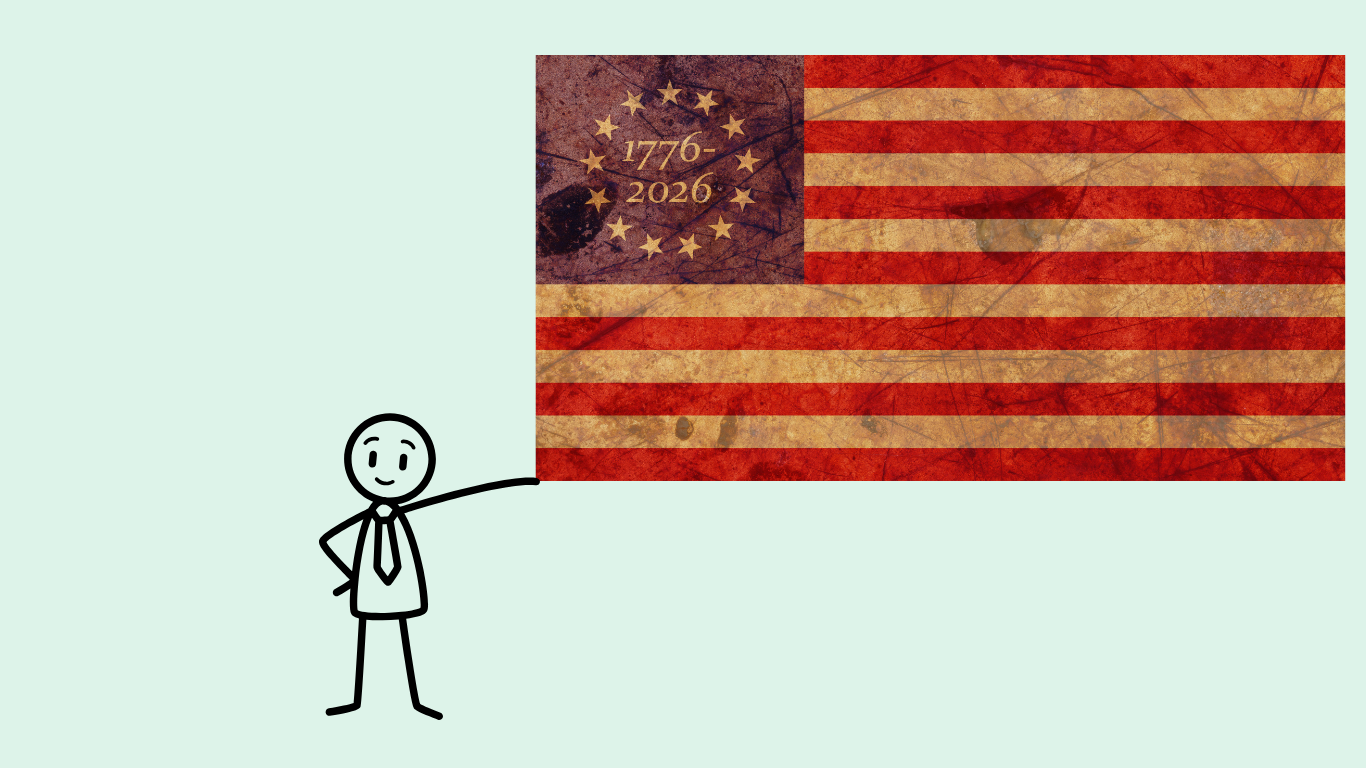
You couldn’t miss America’s 250th birthday this year. It was on the television and in the magazines, in the speeches and the fireworks. It was in the ambient hum of a country reminding itself how old it is. And once or twice I heard the story up close, in rooms with more resources than most of the communities I serve will see in a generation. However it reached me, the story was the same. It’s a proud one, and I share the pride. It’s also an incomplete one. It goes something like this: a great nation was born free, anyone willing to work can rise, and the rising proves the whole thing works. Pull yourself up by your bootstraps. Be grateful. Don’t complain. That may not be the immediately obvious message, but look closely, and there it is.
I remember one of those rooms in particular. A man was telling a lot of us about his father — a man who, he said, made himself. Built a fortune from nothing, became powerful, and then passed it all down: to him, and to his children after him. He meant it, proudly, as a bootstraps story, without calling it as much. He didn’t seem to hear the second half of his own words. Because if the fortune had to be passed down, then the son standing in front of me hadn’t made himself at all. He’d been handed a fortune already made. Yet his focus was on his father’s story much more than his own.
Which is what strikes me now about that man and me. We were both handed something. He inherited resources, and the power that travels with them. I inherited wisdom — the kind passed down by people who had no choice but to live on it. I don’t name these to weigh one against the other, as if his were the heavier gift or mine the nobler one. I’m positive that he carries wisdom of his own, one that only the life he’s lived can bring him. We simply hold different inheritances. But they are both inheritances, and that is the point: neither of us arrived with empty hands. So let me tell you what the bootstraps story leaves out — starting with how many hands it took, outside of our own.
The self-made story forgets that the country settled this question before any of us were born, and carved its answer into the national seal: E pluribus unum. Out of many, one. Not one man who made himself and then, out of generosity, carried the rest — but many, who together made the one. So the self-made American isn’t merely bending the facts of his own life. By the founding motto of the country he means to celebrate, there is no such man — only the many he mistook for one.
The argument we’ve been having for 250 years
I’ve been reading Ben Rhodes’s All We Say: A History of the United States in Fifteen Speeches. The author introduces his readers to fifteen American speeches, and it gave me language for something I’d felt for years but hadn’t named. Rhodes argues that for two and a half centuries we’ve been having one long argument — not really about taxes or borders or any single policy, but about a question underneath all of those: what does it mean to be American, and who gets to decide? And he finds that we’ve only ever offered two answers.
The first answer says America was right from the beginning. It was founded good and free, and its story is one of a great inheritance to be protected. In this version, some people stand at the center by birthright, and everyone else is welcome to join — so long as they arrive grateful and stay quiet. Criticism, in the first story, sounds like ingratitude. To point at what’s broken is to insult what’s sacred.
The second answer says America was founded not as a finished fact but as a promise — a promise of human equality that the country itself did not yet keep. In this version, we are a nation forever in the act of trying to live up to its own founding words. Diversity is not a threat to be managed but the very material the promise is made of. And the struggle to widen the circle, to make “all men are created equal” mean what it says, is the highest form of loving it.
I’m embarrassed to share that it took me longer than it should have to see the bootstraps story clearly. It arrives dressed as the neutral, sensible middle — floating above the argument, claiming no side. But it belongs squarely to the first story, only in an economic costume. Underneath runs a simple claim: the country is already fair, so whatever you built, you built alone, and gratitude is the only fitting response. The story sounds like a tribute to hard work. Its real work is quieter — teaching you to be thankful and to stay silent with appreciation.
What the rising actually took
I cannot tell that story about my own life, because it isn’t true.
I am the son of Mexican immigrants. Every “first” I carry came at a cost the bootstraps myth is designed to hide. It was never easy, and it was never alone. There were teachers who saw something in a kid the system wasn’t built to see. Mentors who opened doors I didn’t know existed. Family who worked so I could study. A grandmother who prayed for me and a grandfather who taught me so much. My hands were among many — out of many — and behind all of us stretched a long line of people who gave more than they were ever given, most of whom never lived to see what their giving would build.
So when I hear the bootstraps version of the American story, I don’t hear a lie about the country so much as a lie about how anyone gets anywhere in it. Nobody rises alone. The myth that we do isn’t just inaccurate; it’s convenient. It lets a country take credit for the people who succeed and assign blame to the people it never lifted.
And this is the part the first story cannot hold: my life is not the exception to the American story. It is the American story — the second one. I am what the promise looks like when it finally reaches someone it was not originally written to include. My firsts are not proof that the system works as advertised. They are proof of the distance a person still has to travel to reach what was supposed to be theirs from the start.
The honest ledger
None of this makes me love the country less, quite the opposite. But an honest love keeps an honest ledger, and ours is heavy.
We should be able to say plainly, even at a birthday party, that the same Constitution we celebrate was written without the voices of women, of the poor, of Indigenous peoples, of the enslaved. “We the People” once meant only some of the people. Benjamin Franklin knew it. Red Jacket, the Seneca leader, told a missionary that his people already had a religion of their own, handed down from their fathers, and that a nation which had taken their land could at least leave them that. Maria Stewart — a widowed Black woman in her twenties, standing before a mixed audience in 1832 when almost no one like her was permitted to — laid it out in an arithmetic no bootstraps story survives: that the labor of the exploited had built the wealth of the comfortable, and the ones who did the planting were not the ones who ate the fruit.
We should also be able to say that every widening of the circle in this country has summoned its own backlash — that the retreat from progress is as American as the progress itself. For every advance toward the promise, there has been a movement to claw it back. That is not cynicism. It is the actual record. And a nation that celebrates only the ground it has gained, and forgets how often that ground has been taken back, is preparing to be caught off guard when it happens again.
Notice, too, what the first story does with the people who named that gap out loud. Take the one it reaches for most often. In its most heartfelt tellings, it now reaches, almost by reflex, for Frederick Douglass, the man who stood before a Fourth of July crowd in 1852 and asked what the holiday could possibly mean to the enslaved. But it reaches for only half of him. It keeps his faith that the founding principles were worth holding to, and quietly sets down the charge he delivered in the same speech: that a nation toasting its own liberty while it held millions in chains was betraying the very words it claimed to revere, and owed it to those words to close the distance. To borrow Douglass’ hope while dropping his indictment is to keep the prophet and edit out the prophecy. And that is the tell, because what Douglass demanded, that America finally become what it said it was, is the second story, top to bottom.
And it is not only its critics the first story reaches for. Follow any self-made hero to the end of his own telling and you find the others already waiting there: the partner, the mentor, the parent whose lessons he is still living out, the hometown that rallied when things fell apart, the long roll of names who came before and left something to build on. The story files them under supporting cast. Read closely, and they are the argument. The self-made story cannot finish a paragraph without reaching for other people — and that reach, every time, is the truth leaking through the myth.
Franklin’s unfinished draft
Which brings me back to Benjamin Franklin, because he is where the two stories can finally be reconciled — not into some weak middle, but into a single, demanding truth.
Franklin supported a Constitution he knew was incomplete. He understood it as a first draft, built well enough to survive and, more importantly, built to be improved. And then he did the improving: one of the last public acts of his extraordinary life was to petition Congress to abolish slavery. He helped build the thing, and in nearly the same breath he went to work making it better. He did not experience those as contradictory acts. They were the same act — the act of loving something enough to refuse to leave it as you found it.
That is the answer I’ve been looking for to my own question about how to hold the good and the bad together. You don’t hold them by splitting the difference, one hand clapping for the founders and the other wagging at them. You hold them the way Franklin did: by treating the country as an unfinished draft that it is your inheritance, and your duty, to keep writing.
The founders even wrote the striving into the grammar. They set out to form a more perfect union — a phrase that reaches past wherever the country happens to stand, and assumes the work is never finished. The reaching lives in the sentence itself.
To celebrate the 250th honestly, then, is not to freeze the country in amber and admire it. It is to pick up the draft. It is to say that the promise is real and unkept, that the circle is wider than it was and narrower than it must become, and that widening it further is not a betrayal of the founders but the most faithful thing their heirs can do.
Still being kept
So here is where I land, as a proud American who is also the son of immigrants, who had to fight for so much, and who would not trade the fight or the country away.
I am grateful — and I refuse to be quiet, because I’ve learned that in the truer of our two stories, gratitude and honesty are not opposites. They are the same devotion. The people I most admire across these 250 years were almost always ahead of their time and full of their own failures at once. They loved the country by telling it the truth. They believed in a promise precisely because it was not yet kept — because an unkept promise is the only kind still worth working for.
Two hundred and fifty years is a long time to be arguing about who we are. I hope we never stop. And I hope my children inherit a country still restless enough to keep the argument going, still unfinished enough to need their hands in the making of the one.
Because the promise was that we’d keep going. De todos modos.
Salvador López is the founder of Todos Modos, where he writes about systems change, community leadership, and social narrative. He is President & CEO of a systems “think and do” tank, a Harvard EdRedesign Cradle-to-Career Fellow, and Chair of the Grand Rapids Community College Board of Trustees. He lives in Grand Rapids, Michigan, with his wife and three children.
Leave a Reply